

Highlights from the AMSE 2026 Conference in Vilnius – AMSE Newsletter – 2026 – No. 11

The international conference AMSE 2026, “Academic Medicine Under Pressure in Times of Uncertainty – Education, Research, Patient Care”, held in Vilnius on 10–12 September, brought together representatives of 33 countries to discuss the future of medical education, research and patient care.Organised by the Association of Medical Schools in Europe (AMSE) and the Faculty of Medicine of Vilnius University (VU), the three-day event explored how academic medicine can remain resilient amid geopolitical conflicts, technological advances, climate change and growing healthcare needs.
“Today, we need not only new knowledge and technologies, but also resilient, critical-thinking and collaborative healthcare professionals,” said Prof. Algirdas Utkus, AMSE Secretary General and Chair of the Conference Organising Committee, highlighting the importance of international dialogue and cooperation.
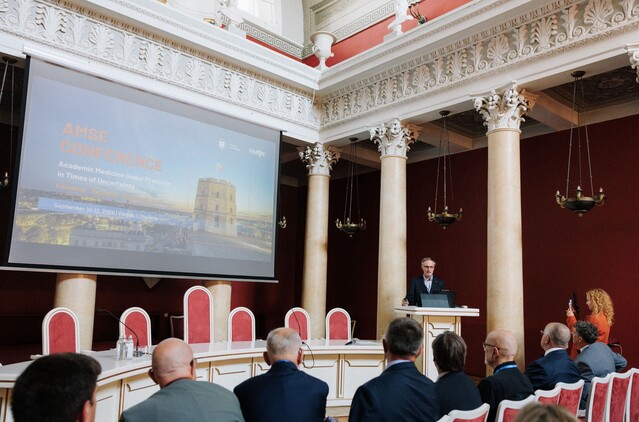
Opening the conference, Juozas Olekas, Speaker of the Lithuanian Parliament, emphasised that the strength of academic medicine lies in connecting education, research and clinical practice to improve people’s lives. VU Rector Prof. Dr. Rimvydas Petrauskas highlighted the university’s international character and expressed hope that the conference would inspire lasting collaborations. Prof. Dr. Dalius Jatužis, Dean of the Faculty of Medicine, stressed the importance of collaboration between healthcare professionals, researchers and students.
| Preparing for Crises and the Future of Medical Education The first day featured practical workshops on emergency medicine, combat trauma care, hypothermia prevention, massive haemorrhage management and bioethics. Discussions also addressed medical education in emergencies and conflicts, drawing on international experience, including the treatment of war-related trauma in Ukraine. |
Participants explored the harmonisation of medical competencies, professional mobility and the evolving skills required of Europe’s healthcare workforce. Speakers included former Lithuanian Health Minister and European Commissioner Vytenis Povilas Andriukaitis, representatives of the World Health Organization Regional Office for Europe, the European Observatory on Health Systems and Policies, and the European Commission. Rare disease research networks and the expectations of patients and future doctors were also discussed.
| Connecting Education, Research and Patient Care The second day focused on integrating education, research and clinical practice. Presentations showcased approaches ranging from peer teaching and collaborative learning to academic ecosystems linking education, research, innovation and healthcare. |
Artificial intelligence (AI) and digital technologies were another major focus. Discussions examined the AI competencies future healthcare professionals need and the risks of digital misinformation in medical education. Speakers also emphasised that technological transformation must be accompanied by trust.
Sustainability was explored through discussions on incorporating environmental goals into medical curricula and institutional governance, alongside the changing needs of health systems.
Rare diseases and personalised medicine received particular attention. The session “Bridging the Gap: Personalized Therapies for Rare Conditions” examined advances in genomics, European partnerships, education and the ethical challenges of personalised treatments.
| Student Wellbeing and the Next Generation of Healthcare Professionals Student mental health emerged as another key theme. Researchers from Lithuania, the United States and Chile discussed student burnout, peer support, the effects of the pandemic and mental health challenges during global crises. VU researchers Assoc. Prof. Dr. Arūnas Žiedelis and Assoc. Prof. Dr. Inga Truskauskaitė presented research on burnout and student mental health trajectories. |
The discussions highlighted that resilient healthcare systems depend on professionals who can adapt to uncertainty, making psychological wellbeing an essential part of medical education.
Medical students also contributed to the conversation through a programme exploring career opportunities in regional areas and major cities, as well as the resilience of health professions educators. Kristina Pavloski represented the European Medical Students’ Association.
| Celebrating Research and International Collaboration The conference concluded with awards for young researchers for outstanding presentations. Afonso Resende and co-authors received the best oral presentation award for “The Association Between Teaching Motivation And Satisfaction In Clinical Teachers: A Cross-Sectional Study”. Ainis Lukša and co-authors won the best poster award for “The Lithuanian Medicine Olympiad: Bridging Secondary Education and Medical Careers”. AMSE 2026 demonstrated that the future of academic medicine depends on collaboration across countries and disciplines |
Best wishes from Berlin,
Harm Peters